

As demand for premium packaging continues to grow, printers are increasingly looking to offer high-quality UV, Drip-Off, Spot UV and specialty coating effects. When investing in a coating solution, there are generally two choices:
- Purchase a converted offset printing press
- Invest in a purpose-built coating machine
While converted presses may appear attractive because of their lower purchase price, they were originally designed for printing—not coating. As a result, they involve compromises in coating quality, productivity, operating costs, maintenance, safety and long-term reliability.
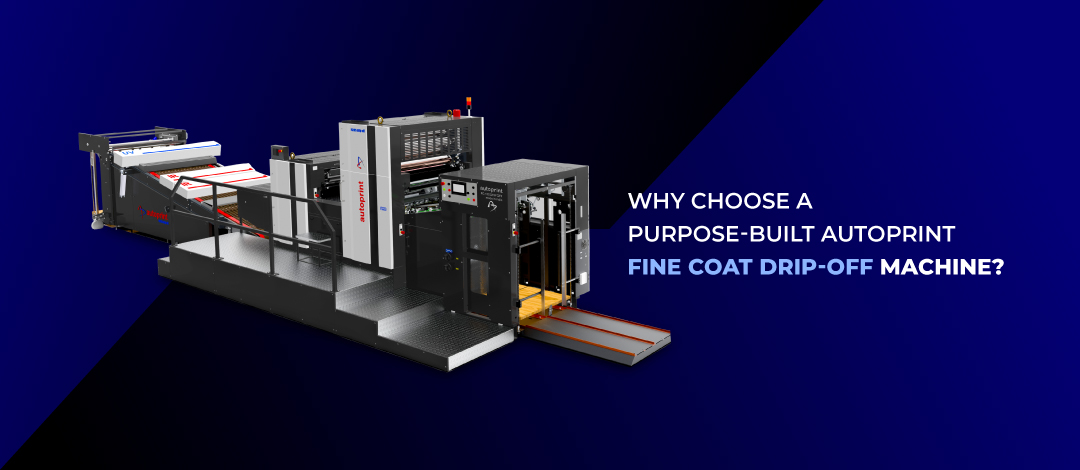
The Autoprint Fine Coat Drip-Off Series has been engineered exclusively for coating applications. Every component has been designed to maximize productivity, minimize maintenance and deliver consistent, premium coating quality over many years of operation.
What is a Converted Press?
A converted press is typically a 25–50-year-old Heidelberg single- or two-colour offset printing press that has been modified by adding coating units, UV dryers and auxiliary systems to perform coating operations.
Although these machines can produce coated work, the original press was never designed for continuous coating production. Consequently, many limitations of the original printing press remain.
Comparison at a Glance
| Feature | Converted Press | Autoprint Fine Coat |
|---|---|---|
| Purpose-built for coating | ✕ | ✓ |
| Brand new machine | ✕ | ✓ |
| Fine-grain Drip-Off effects | ✕ | ✓ |
| Larger coating cylinder geometry hence Scratch-free sheet transport | ✕ | ✓ |
| Variable varnish deposition using same anilox roller | ✕ | ✓ |
| Fast UV/Aqueous varnish changeover | ✕ | ✓ |
| Lower power consumption | ✕ | ✓ |
| Shutter-type UV system | ✕ | ✓ |
| Ability to switch off the Offset tower - Hence Rubber rollers not wear when only 2nd tower is used. | ✕ | ✓ |
| Blister coating capability | Limited | ✓ |
| Lateral & Circumferential blanket adjustment - Hence Blankets can be re-used for repeat jobs | ✕ | ✓ |
| Easy gripper removal for service and maintenance | ✕ | ✓ |
| Easier maintenance - Lower maintenance cost - Lower operating cost | ✕ | ✓ |
| Automatic operation | Limited | ✓ |
| Single operator operation | ✕ | ✓ |
| Single source for service support | ✕ | ✓ |
Why Autoprint Performs Better
Purpose-Built for Coating
Unlike converted presses, every major component of the Autoprint Fine Coat has been designed specifically for coating applications.
The result is:
- Higher productivity
- Better coating quality
- Easier operation
- Greater reliability
- Lower lifetime ownership cost
Exclusive Fine-Grain Drip-Off Capability
One of the biggest differentiators of the Autoprint Fine Coat is its ability to produce fine-grain Drip-Off effects.
This premium finish is only possible on the Autoprint platform and allows converters to produce luxury packaging effects that are extremely difficult to achieve consistently on converted presses.
Ideal applications include:
- Cosmetics
- Pharmaceuticals
- Liquor cartons
- Premium FMCG packaging
- Luxury packaging
Variable Varnish Deposition with the Same Anilox Roller
The Autoprint Fine Coat allows operators to vary varnish deposition by 0.5gsm +/- while using the same anilox roller.
Benefits include:
- Greater production flexibility
- Better coating control
- Reduced anilox inventory
- Faster job setup
- Lower consumable costs
Converted presses generally require changing the anilox roller whenever a different coating weight is required.
Superior Cylinder Design
Unlike converted presses that retain the cylinder dimensions of an old offset press, Autoprint cylinders have been designed specifically for coating.
Advantages of Larger Cylinders
The larger cylinder geometry provides:
- Better sheet support
- Reduced sheet curvature
- Improved coating uniformity
- Better handling of thicker board
- Reduced sheet marking
- Higher production stability
Scratch-Free Production
Except for the Heidelberg CD102, almost every converted coating machine is prone to scratches and sheet marking because of its sheet path and cylinder geometry.
The Autoprint Fine Coat has been engineered to minimise these issues, delivering cleaner sheets and superior finished cartons.
Rapid UV / Aqueous Varnish Changeover
Changing from UV varnish to aqueous coating is one of the most frequent production requirements.
Autoprint supplies:
- Two stainless steel coating trays
- Separate coating pumps
The operator simply:
- Removes the existing tray.
- Installs the already-cleaned second tray.
- Connects the second pump.
- Resumes production.
Typical changeover time is approximately 15 minutes.
Converted presses require cleaning and reinstalling the same tray and thoroughly cleaning the coating system before restarting production, typically taking approximately twice as long.
Lower Power Consumption
The Autoprint Fine Coat has been engineered for energy-efficient operation.
Savings are achieved through:
- Lower main drive power
- Lower dryer power
- Efficient UV design
- Ability to disengage unused coating units
Typical saving:
Approximately ₹150 per operating hour
Converted presses require:
- Larger main drive motors
- Higher-capacity dryers
- Continuous running of both coating units
- Higher UV power consumption
Intelligent UV System
Autoprint uses a shutter-type UV lamp, similar to modern UV printing presses.
The UV lamp:
- Opens only when a sheet passes
- Operates at full power only during production
- Automatically reduces to approximately 10% standby power when no sheet is present
Benefits include:
- Additional power saving of approximately ₹50/hour
- Lower operating temperatures
- Longer bearing life
- Reduced maintenance
- Lower fire risk
Converted presses typically mount the inter-deck UV lamp on the impression cylinder due to space constraints.
These UV lamps remain continuously ON whenever the machine is running, resulting in:
- High electricity consumption
- Increased cylinder temperatures
- Shorter bearing life
- Higher maintenance
- Increased fire risk
Switch Off the First Coating Unit
Approximately 50–70% of coating jobs involve only Spot UV or aqueous coating. On the Autoprint Fine Coat:
- The first coating unit can be completely disengaged.
- Rollers remain unused.
- Roller and bearing life are significantly increased.
On converted presses:
- The first unit continues rotating even when not required.
- Roller wear cannot be avoided.
Three-Roller Coating System
Autoprint employs a unique maintenance-free three-roller coating system
Advantages include:
- Easy adjustment of coating thickness
- No need to frequently change anilox rollers
- Lower maintenance
- Lower operating cost
Converted presses generally use a chamber doctor blade system.
Disadvantages include:
- Frequent doctor blade replacement
- Multiple expensive anilox rollers
- Longer setup times
Wider Coating Capability
The Autoprint Fine Coat is capable of producing:
- UV coating
- Spot UV
- Drip-Off
- Aqueous coating
- Blister coating
This is achieved through:
- Additional IR lamps
- Three-roller coating system
- Purpose-built coating architecture
Blister coating is generally difficult to achieve on converted machines.
Easier Maintenance
Coating machines inevitably become coated with varnish during production. Autoprint has been designed specifically for easy maintenance.
Examples include:
- All grippers can be removed within approximately 15 minutes.
- Complete cleaning and refitting can normally be completed within approximately 2 hours.
- Autoprint engineers provide technical guidance whenever required.
This is particularly important because aqueous coating is highly adhesive and can affect gripper performance if not cleaned regularly.
Converted Machine Maintenance
Converted machines were never designed for coating.
Consequently:
- Gripper removal is difficult.
- Resetting requires experienced technicians.
- Cleaning can take one or two days.
- Finding technicians capable of servicing 40–50-year-old presses is becoming increasingly difficult.
Machine Reliability
Every Autoprint Fine Coat is supplied as a completely new machine.
Benefits include:
- New mechanical components
- New electrical system
- New bearings
- New drive system
- Factory warranty
- Proven machine design
Converted presses begin life as 40–50-year-old offset presses. Although refurbished, many original components remain and are naturally subject to age-related wear and unexpected failures.
Better Machine Layout
Autoprint machines provide optimum spacing between coating units.
Benefits include:
- Easier plate changing
- Easier blanket changing
- Easier cleaning
- Better operator access
- Improved safety
Converted presses have significantly less working space because additional coating equipment has been fitted within the original press frame.
Fully Automatic Operation
Autoprint machines are designed using modern automation.
Features include:
- Touch-screen operation
- Pneumatic controls
- Automatic sequencing
- Safety interlocks
- Automatic machine functions
One operator can comfortably run the machine.
Converted presses generally require more manual intervention and typically need two operators for efficient production.
Faster Repeat Jobs
Autoprint provides both:
- Circumferential adjustment
- Lateral blanket adjustment
Lateral adjustment allows the blanket to be repositioned and reused.
Converted presses generally do not offer lateral adjustment, making blanket reuse extremely difficult because registration is lost.
This significantly increases blanket consumption and setup costs.
Single Source of Technical Support
Purchasing an Autoprint Fine Coat provides one responsible partner.
Autoprint supports:
- Machine
- UV system
- Coating process
- Installation
- Spare parts
- Operator training
- Worldwide technical service
With converted presses, customers often need to coordinate separately with:
- UV supplier
- Machine rebuilder
- Electrical supplier
- Independent Heidelberg mechanics
This often results in delayed troubleshooting and increased downtime.
Complete Operator Training
Autoprint supplies more than a machine.
Our engineers train customers to:
- Select the correct coating
- Set coating thickness
- Optimize UV curing
- Produce premium Drip-Off effects
- Achieve commercial production quickly
Converted machine suppliers generally provide the machine only, leaving customers to develop coating expertise independently.
Built to Handle Coating Materials
UV and aqueous coatings inevitably spill during production.
Autoprint uses stainless steel and corrosion-resistant materials wherever practical, making cleaning easier and extending machine life.
Converted presses, originally designed for printing inks rather than coating materials, are considerably more susceptible to corrosion and higher maintenance over time.
The Autoprint Advantage
When comparing a converted coating press with a purpose-built Autoprint Fine Coat, the difference extends far beyond the purchase price.
The Autoprint Fine Coat delivers:
- Purpose-built coating design
- Brand-new machine with factory warranty
- Superior Drip-Off quality
- Exclusive fine-grain Drip-Off capability
- Variable varnish deposition using the same anilox roller
- Larger coating and transfer cylinders
- Rapid 15-minute UV/Aqueous changeovers
- Lower power consumption
- Intelligent shutter-type UV system
- Ability to disengage the first coating unit
- Better sheet handling
- Reduced scratching
- Three-roller maintenance-free coating system
- Blister coating capability
- Easier maintenance
- Faster cleaning
- Longer roller and bearing life
- Lower consumable costs
- Lower operating costs
- Single-operator production
- Comprehensive operator training
- Worldwide service support
- Higher productivity
- Longer machine life
- Lower total cost of ownership
The Bottom Line
A converted press extends the life of an old printing machine—but it remains a compromise.
The Autoprint Fine Coat Drip-Off Series is a purpose-built coating solution designed for modern packaging production.
It offers higher productivity, superior coating quality, lower operating costs, easier maintenance, and reliable worldwide support, making it the better long-term investment for commercial and packaging printers seeking premium coating performance.